
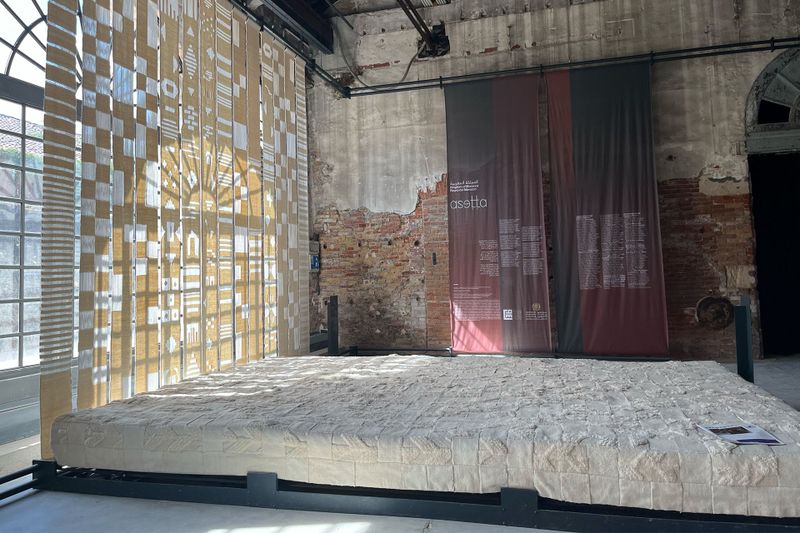
Hey travelers, are you looking for information and photos of the Morocco Pavilion Venice Biennale 2026? You discover all in this complete content by Venice Insider Guide.
The Morocco pavilion at the 61st International Art Exhibition is the Kingdom of Morocco's first national pavilion at La Biennale di Venezia, installed in the Arsenale's Sale dell'Artiglieria.
Let's find out information, review and images.
Morocco Pavilion Venice Art Biennale 2026
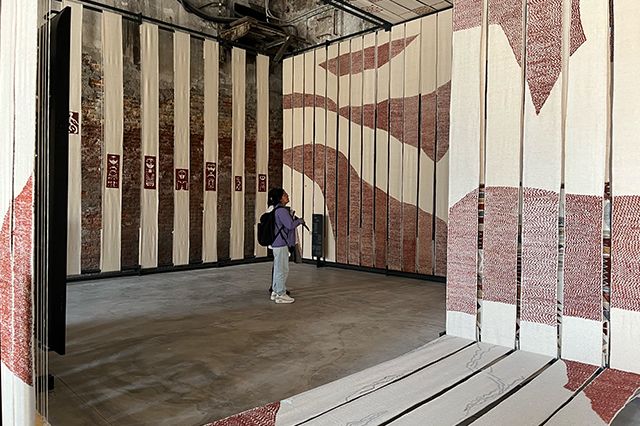
Morocco's first national pavilion opens at the Venice Biennale in 2026, marking the Kingdom of Morocco's entry into one of the oldest and most watched exhibitions in contemporary art. Moroccan artists have appeared in group and collateral shows at La Biennale di Venezia before, but this is the first time Morocco presents a dedicated national pavilion with full institutional backing.
The Marocco Pavilion at Venice Art Biennale 2026 is organized under the auspices of the Ministry of Youth, Culture and Communication. Artist Amina Agueznay designed the installation; curator Meriem Berrada shaped its narrative framework.
The Moroccan Pavilion Venice Biennale 2026 occupies approximately 300 square metres in the Arsenale's Artiglierie halls, positioning Moroccan art within the central route of Biennale Arte 2026. Morocco's pavilion represents a concrete step in the country's presence in the global art scene.
Asǝṭṭa: Concept, Title and Spatial Experience
The Morocco Pavilion Venice Biennale 2026 features a monumental installation titled Asǝṭṭa, an Amazigh word for ritual weaving. The term carries layers beyond textile production: it binds technique to prayer, memory, and sacred cycles. Asǝṭṭa is conceived as a large-scale installation designed around the concept of the threshold, drawing on the Moroccan architectural notion of the âatba, the space that is neither inside nor outside, mediating passage between private and public, visible and invisible.
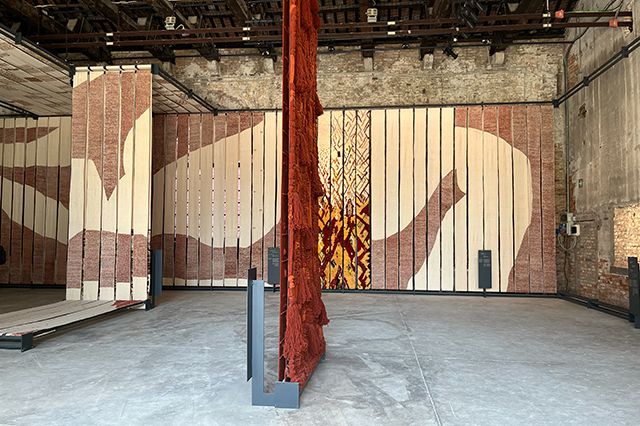
The installation features over 200 massive woven panels, suspended from frames across the Artiglierie.
These bands form corridors, veils, and porous partitions rather than solid walls. Visitors move through shifting light, shadow, and texture; the work changes with proximity and angle. Asǝṭṭa explores traditional craftsmanship and shared memory, functioning as a continuous, immersive environment rather than a sequence of discrete artworks. The exhibition runs from May 9 to November 22, 2026, open six days a week with seasonal hours.
Artist Amina Agueznay and Curator Meriem Berrada
Amina Agueznay, born in 1963 in Casablanca, trained as an architect in the United States and practiced for about ten years before returning to Morocco. Her multidisciplinary practice spans jewelry, textile, and installation. Amina Agueznay's projects develop through workshops with local artisans, with previous works including Skin (2011), Noise (2016), and Curriculum Vitae (2021). Each project involved sustained collaborations with rural and urban craft communities, turning everyday materials into contemporary art language.
Meriem Berrada, born in 1986 in Fez, is artistic director of MACAAL (Musée d'Art Contemporain Africain Al Maaden) in Marrakech. Her curatorial practice avoids folkloric tropes, framing Moroccan craft as experimental and alive within broader African and Arab world conversations.
For the Marocco Pavilion Venice Biennale 2026, Agueznay acts as conductor of a polyphonic creation; Berrada positions the work within the Biennale's theme and ensures artisans are visible as co-creators, calling the project "a living archaeology of gestures." Their collaboration bridges Moroccan vernacular knowledge and international art circuits.
Morocco Pavilion Venice Biennale 2026: Craftsmanship as Contemporary Knowledge
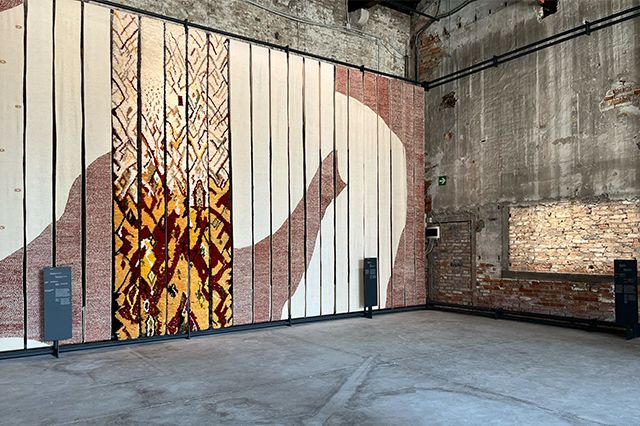
The Morocco Pavilion Biennale 2026 treats craft traditions not as relics for preservation but as active knowledge production. The project emphasizes craftsmanship as knowledge production, focusing on the transmission of knowledge and cultural memory through craftsmanship.
The pavilion aims to highlight Morocco's diverse artisanal techniques and challenges the traditional separation between fine art and craft.
166 Moroccan artisans collaborated on the Asǝṭṭa installation, drawn from regions including the High Atlas, Middle Atlas, Souss-Massa, and the province of Jerada. The majority of artisans involved in the project are women. Artisans contributed to various disciplines like embroidery, basketry, bead-work, braiding, and leatherwork. The design employs traditional Moroccan techniques, integrating craft in contemporary art. Each technique becomes a narrative gesture in the installation, connecting ancestral narratives to contemporary storytelling.
These are not decorative choices; they encode regional identity and shared memory across generations. The artisans, credited as co-creators rather than anonymous labor, bring forms from Amazigh, Arabic, Saharan, and coastal traditions into a single space.
Moroccan Pavilion Venice Biennale 2026: Material, Gesture and more
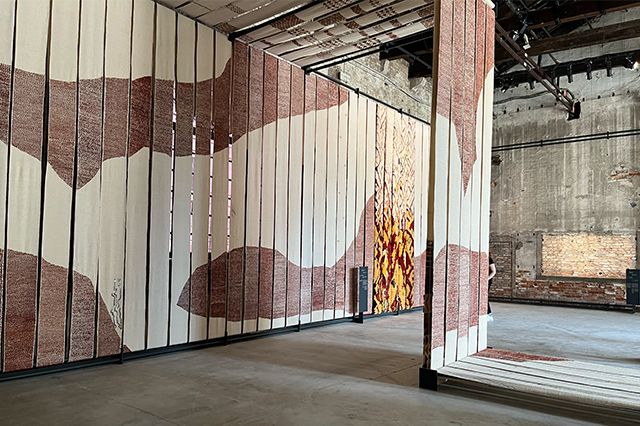
Biennale Arte 2026's thematic framework, In Minor Keys, was shaped by curator Koyo Kouoh and her team. The theme calls for listening to low frequencies, noticing what is quiet, what is marginal. The Moroccan Pavilion Venice 2026 embodies the theme In Minor Keys, emphasizing subtle narratives and communal practices rather than spectacle.
Materials form an alphabet legible through touch and sight. The installation uses naturally dyed and spun wool from Tiflet alongside raphia, leather, glass beads, and metal rods. Asǝṭṭa incorporates traditional geometric and ancestral shapes drawn from Moroccan vernacular architecture.
The centrality of gesture; repetitive motions of weaving, knotting, bead-insertion; echoes workshop rhythms and domestic spaces. Some materials reference Mediterranean exchange: glass "rosetta" beads evoke Murano's bead-making heritage, threading cross-cultural circulation into the fabric itself.
The narrative is non-linear and polyphonic. Visitors encounter overlapping temporalities and geographies stitched into the pavilion's second skin. Instead of monumental nationalism, the work foregrounds collective care and equality between voices.
Morocco Pavilion Venice Biennale 2026 in the Global Contemporary Art Landscape
Morocco's pavilion builds on institutional momentum: the Marrakech Biennale (founded 2005), the 1-54 Contemporary African Art Fair, MACAAL, and new galleries in Casablanca and Rabat have expanded international visibility for Moroccan artists over the past decade. The Moroccan Pavilion Venice Biennale 2026 strengthens the Kingdom of Morocco's cultural diplomacy by projecting plurality rather than a single touristic image. Morocco's pavilion challenges stereotypes of stable cultural images, foregrounding the country as a negotiated, evolving cultural space.
Early press reception has been favorable. Art Newspaper, Vogue Arabia, and Architectural Digest each identified the Morocco Pavilion Venice Biennale 2026 as one of the edition's standout presentations, noting its immersive scale and alignment with the Biennale's theme. Possible legacies include adapting Asǝṭṭa's modular components for Moroccan museums, inspiring further art-craft-community collaboration in Africa, and influencing how national pavilions from the region present craft as contemporary art rather than ethnographic artifact.
FAQ
Below are answers to common questions about the Moroccan pavilion at Venice Biennale 2026 not fully covered above.
Where exactly is the Morocco Pavilion Venice Biennale 2026 located within the Venice Biennale?
The Moroccan pavilion at Venice Art Biennale 2026 is installed in the Sale dell'Artiglieria within the Arsenale complex, one of La Biennale di Venezia's two main venues alongside the Giardini. Visitors reach it along the standard Arsenale exhibition route, following signage for the Kingdom of Morocco national pavilion.
How long will the Morocco Pavilion be on view during Biennale Arte 2026?
The pavilion runs from May 9 to November 22, 2026. From May through September, hours are 11:00 to 19:00 (extended to 20:00 on Fridays and Saturdays). October through November hours shift to 10:00 to 18:00. The pavilion closes on Mondays, with a few exceptions.
Is Asǝṭṭa a permanent work or will it travel after Venice?
Asǝṭṭa was specifically designed for the architecture and scale of the Arsenale's Artiglierie. The installation in its current form is temporary. Its modular band components could be adapted for future displays in Moroccan museums or international institutions, though no touring plans have been confirmed publicly.
How does the pavilion represent different regions and cultures within Morocco?
The 166 artisans come from local communities across the High Atlas, Middle Atlas, Souss-Massa, Jerada, Tiflet, and coastal areas. Their techniques and motifs reflect Amazigh, Arab, Saharan, and coastal craft forms. The Morocco Pavilion Venice Biennale 2026 avoids presenting a single official image of Moroccan identity, instead showing Morocco as a plural, negotiated cultural notion.
Can visitors learn more about the artisans and processes behind the work?
Wall texts, printed guides, and digital content at the Morocco Pavilion Venice Biennale 2026 provide background on artisan contributions, workshops, and materials. Visitors can also follow up through institutions like MACAAL and the Ministry of Youth, Culture and Communication for deeper resources on Moroccan art, youth culture and communication initiatives, and ongoing craft collaboration between artists and artisans.
Conclusion
The project, titled Asǝṭṭa, is a monumental installation created by artist Amina Agueznay and curated by Meriem Berrada, featuring over 200 massive woven panels that form a living membrane visitors walk through.
166 Moroccan artisans from regions including Souss-Massa, the Middle Atlas, and Tiflet collaborated on the installation, with the majority being women.
The Morocco Pavilion at the Venice Art Biennale 2026 challenges the traditional separation between fine art and craft, treating Moroccan craftsmanship as contemporary knowledge production rather than decorative heritage.
The pavilion runs from May 9 to November 22, 2026, and contributes to a broader momentum for Moroccan and African art on the world stage.
Our review of the Morocco Pavilion Biennale 2026 is very positive. We loved both the installation and the concept. We were completely blown away.
Now that you know all the information and have seen the photos, will you go?
Follow us Venice Insider Guide!
- The photos in this article of the Morocco Pavilion Art Biennale 2026 are the property of Venice Insider Guide.