
Hey travelers, looking for information about how to visit Borges Labyrinth in Venice? You're in right place.
Venice - that wacky, wonderful, labyrinthine city of canals and bridges that's just made for getting lost in. And what better way to celebrate that than with a real-life maze that's a testament to one of literature's most beloved writers? Perched on a teeny-tiny island just a short vaporetto ride away from St. Mark's Square, the Borges labyrinth in Venice is a must-see for anyone who loves Borges, or just getting lost.
In this guide by Venice Insider Guide about Borges Labyrinth Venice, you discover:
- The Borges labyrinth (Labirinto Borges) is a boxwood garden-maze on San Giorgio Maggiore island in Venice, created in 2011 and opened to the public for the first time in June 2021.
- British architect Randoll Coate designed the maze to pay homage to Jorge Luis Borges and his story "The Garden of Forking Paths."
- Visits are only possible on guided tours at fixed times; booking in advance is required through the Giorgio Cini Foundation.
- The kilometer long path features symbolic hedges, an original soundtrack by Antonio Fresa, and a panoramic view from the San Giorgio bell tower that reveals the maze's book like shape.
- Ideal for literature lovers, garden enthusiasts, and anyone seeking a quiet alternative to crowded Venice sights.
Borges Labyrinth in Venice: Origins and Literary Inspiration
Borges viewed Venice as a labyrinthine city with intricate canals and streets - one of his beloved cities and a mirror of the philosophical structures he spent a lifetime building in prose. It was among his most inspired settings, a unique city that seemed to exist in the same work of infinite reflection as his fiction. So when the Giorgio Cini Foundation decided to honor his legacy, the island of San Giorgio Maggiore was the natural choice.
The labyrinth was created in 2011 to honor Jorge Luis Borges on the twenty-fifth anniversary of Borges death. Commissioned in collaboration with his widow Maria Kodama - Borges widow and lifelong literary partner from Buenos Aires - the project brought to life a plan that Randoll Coate designed decades earlier. Coate, a British labyrinth architect, had conceived the design in the 1980s, drawing directly from the Borges short story "The Garden of Forking Paths," a seminal work featuring a metaphysical labyrinth where forking paths represent branching time and choices. Borges frequently used labyrinths to symbolize chaos and infinite possibilities, and he considered the labyrinth a foundational symbol in his literature. His labyrinths are often philosophical and textual structures, representing the complexity of the universe and human knowledge.
The Borges labyrinth Venice opened to the public in June 2021. It features approximately 3,200 boxwood plants forming about one kilometre of hedges on the former monastery vineyard next to the Manica Lunga - now the New Manica Lunga library. In plan view, the garden takes the shape of an open book. Embedded within its paths are symbolic figures: the name Borges written twice in opposite directions, an hourglass, a huge question mark, a tiger, a walking cane, and the initials M and K for Maria Kodama.
Design, Symbols and Experience Inside the Borges Labyrinth Venice
Step through the entrance and you find yourself inside green corridors formed by low boxwood hedges - roughly 90 cm to one metre in height - winding through the cloister-like silence of San Giorgio. The hedges are low enough to see over, but the paths twist enough that you quickly lose your bearings at ground level.
From above, the full design becomes clear. Looking down from the bell tower or the manica lunga terrace, the drawing of an open book dedicated to Borges emerges, accompanied by every symbol Coate hid in the layout. The labyrinth's design includes symbols like hourglasses and mirrors, reflecting Borges's themes of time, doubles, and parallel realities. The tiger evokes his poetry; the question mark signals philosophical doubt; the bifurcating paths echo the garden of forking paths and its multiple narratives. In Borges's stories, labyrinths often represent branching time and choices - and walking these corridors, that idea becomes tangible.
The sensory experience is completed by a multilingual audio guide narrating Borges's ideas while you walk, accompanied by an original soundtrack composed by Antonio Fresa and recorded with the Teatro La Fenice orchestra - sometimes also referred to as the la Fenice theater orchestra. The suite, titled Walking the Labyrinth, unfolds across four movements. The route is designed as a single safe path rather than a frustrating puzzle, with special attention to accessibility, including tactile elements and narration for visually impaired visitors. A standard tour lasts about 45 minutes.
San Giorgio Maggiore Island and the Giorgio Cini Foundation
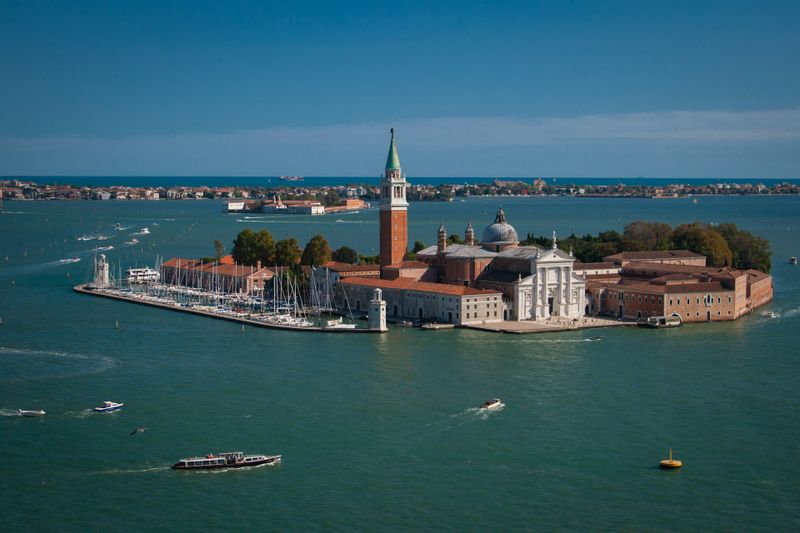
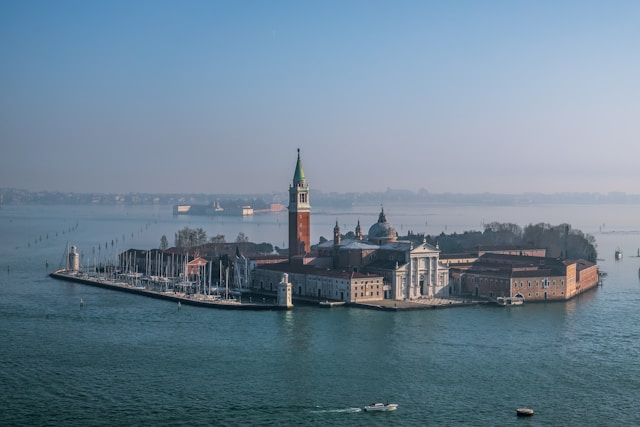
The Borges labyrinth in Venice sits within a wider cultural landscape worth exploring. San Giorgio Maggiore island is a small island directly facing St. Mark's Square across the basin - close enough to see, quiet enough to feel like a different world. Its equally wonderful history stretches back centuries.
The Basilica of San Giorgio Maggiore, designed by Andrea Palladio in the late sixteenth century, anchors the island visually. Behind it lies a former benedictine dormitory and monastery complex where Benedictine monks lived and worked from the tenth century onward. The Giorgio Cini Foundation was established on April 20, 1951 by Vittorio Cini. The foundation promotes cultural and artistic institutions in Venice, restoring the monastery buildings and developing research, music, and exhibition programs. Its library contains 300,000 volumes in the humanities, housed in the manica lunga library extension designed by architect Michele de Lucchi.
Beyond the labyrinth, visitors can explore the vatican chapels, cloistered gardens, art collections, and temporary exhibitions. The San Giorgio bell tower offers a lift to the top, providing a panoramic view of the lagoon and - crucially - a complete overhead view of the labyrinth design. This is the moment for photographs and the clearest way to appreciate the same name and symbols hidden in the hedges.
Plan at least a half day on the island to experience the Cini Foundation's offerings beyond the maze itself.
How to Visit the Borges Labyrinth Venice: Tickets, Guided Tours and Practical Info
Access to the Borges labyrinth in Venice is only possible on organised visits at fixed times. Booking in advance is required - you cannot simply walk in. Guided tours last 45 minutes inside the Borges labyrinth Venice and are available daily except Wednesdays. Tours include the audio guide, the music composed by Antonio Fresa, and access to viewing areas.
Typical ticket pricing runs around €14–15 for adults, with reduced rates of approximately €12–13 for seniors, students, and Venice residents. Children under six generally enter free. Combined tickets with the vatican chapels or additional foundation spaces cost around €18. Verify current prices on the official Cini Foundation ticketing page before your visit.
What's included in the tour: a multilingual audio guide (Italian, English, French, German, Spanish), small-group guided accompaniment, access to the new manica lunga area, and the musical soundtrack experience.
Getting there: take ACTV vaporetto line 2 from San Zaccaria or Piazzale Roma to the San Giorgio stop. Disembark directly in front of the basilica. Walk a few metres to the left-hand side where the ticket office and meeting point are located. Arrive at least ten minutes before your scheduled slot - latecomers typically cannot join once the tour has started.
Private guided tours for small groups, schools, or literary circles are available on request via the Cini Foundation's contact channels and can combine the labyrinth with a wider tour of the island of San Giorgio.
Practical Tips: What to Bring and When to Go
The Borges labyrinth Venice is an outdoor garden on the island, so prepare for Italian weather. Wear comfortable walking shoes - paths are flat but gravel can be slippery after rain. In summer, bring sun protection; in spring and autumn, layer up. A waterproof jacket is wise year-round.
Expect typical lagoon garden wildlife: bees, butterflies, lizards, and in warm months, mosquitoes. Insect repellent helps, especially for those with sensitivities.
Best times to visit are morning or late afternoon during high summer to avoid peak heat. Clear weather is ideal if you plan to climb the bell tower. Pets are generally restricted, with guide dogs for visually impaired guests accepted. Stay on the paths, respect the hedges, and keep photography to personal use - drones and professional shoots require prior authorisation.
Combine a morning at the labyrinth and Cini Foundation with an afternoon exploring the present attractions around St. Mark's area to make the most of your day in the lagoon.
FAQ about the Borges Labyrinth in Venice
When is the Borges Labyrinth in Venice open to visitors?
The labyrinth generally opens from spring right through to late autumn, with reduced opening times in the winter. Visit times are fixed each day, between 10:00 and 17:00, but the full calendar does change annualy, so keep an eye on the official Giorgio Cini Foundation website for the latest - you can expect any special events or maintenance work to alter the schedule.
Can I walk the Borges Labyrinth Venice on my own?
No, access is strictly limited to scheduled visits with a guide and audio guide. This is really to preserve the labyrinth and make sure the whole story comes across - you walk the maze with the music and the narrative. Just strolling in off the street to have a look isn't an option I'm afraid.
Is the Borges Labyrinth in Venice Italy suitable for kids and families to visit?
Yes, and kids love it. The walk to the maze is short and pretty low-key, and exploring all the twists and turns is a real hooray for the young ones. There are also family tickets available, with some pretty sweet deals on entry prices for the wee ones - the little ones get in free or half price in some cases. When you do go, make sure to keep a close eye on the little rascals, as they can easily wander off - and please, for the love of the gardens, keep them on the path and away from the hedges - it's the only way to keep them safe and the hedges from getting trampled.
Can people with mobility or visual impairments get around the Borges Labyrinth?
Fairly decent news here - the paths are pretty flat and the hedges aren't so tall that they get in the way, which makes it a lot easier to find your way around. Some bits have got tactile bits and Braille labels with some of the garden's info on it - the "garden of forking paths" bit is a nice touch, by the way. But full wheelchair access - that's a different story altogether - depends a bit on what the path's made of and how the weather's doing. If you're planning on coming over, your best bet is to get in touch with the Cini Foundation in advance and see what they can do for you. They might even be able to sort you out with a private tour or something like that.
Do you have to climb the bell tower to get a full appreciation of the labyrinth?
Short answer: no, because the labyrinth is pretty cool even from the walkways - the audio guide and all the other sensory bits do their job just fine, even from down at ground level. But - if you can make it to the top of the bell tower on the San Giorgio - well, you get a great view of all the shapes and the name of the thing - it's really worth it if the day is clear. I mean, it won't be the end of the world if you can't make it, but honestly - give it a go if you can - you won't regret it.
Conclusion
So, Borges labyrinth in Venice is beautiful! It:
- was among his most inspired settings;
- a unique city that seemed to exist in the same work of infinite reflection as his fiction
- in the island of San Giorgio Maggiore.
Now, you know all the information for to visit Borges Labyrinth Venice. How to visit is easy!
Follow us Venice Insider Guide!