
Hey travelers, the Luxembourg Pavilion Venice Biennale 2026 brings one of the most provocative national presentations to Venice this year. At Venice Insider Guide, we went to visit the Luxembourg Pavilion Biennale 2026 and took some photos. We want to give you all the necessary information.
The Luxembourg Pavilion - with "La Merde" by Aline Bouvy - participates in the 61st International Art Exhibition - La Biennale di Venezia (Biennale Arte 2026), located in the Arsenale, Sale d'Armi, 1st floor, with the exhibition running from May 9 to November 22, 2026.
Here's everything you need to know about the project, the people behind it, and how to experience it yourself. Let's find out in this post by Venice Insider Guide.
Luxembourg Pavilion Venice Biennale 2026: what to know
The Venice Biennale is the world's most prominent recurring exhibition of contemporary art, drawing hundreds of thousands of visitors every two years. For its 2026 edition, the 61st International Art Exhibition - La Biennale di Venezia assembles national participations from around the globe, each presenting independently commissioned projects that reflect the state of art and culture today. Luxembourg is among these participants, contributing a pavilion that has generated significant attention even before opening day.
The Luxembourg Pavilion Venice Biennale 2026 is one of the official national participations of the art exhibition La Biennale di Venezia, running from 9 May through 22 November 2026. Hosted in the Arsenale complex at Sale d'Armi 1st floor, Campo della Tana 2169/F, Sestiere Castello, Venice, the pavilion occupies a central, heavily trafficked position among the Biennale Arte venues. Kultur | lx (Arts Council Luxembourg) serves as the official commissioner for the Luxembourg Pavilion, on behalf of the Luxembourg Ministry of Culture.
The project on display is titled La Merde - French for "the shit" - by Aline Bouvy, curated by Stilbé Schroeder.
It is a research-based, deliberately provocative exploration of bodies, waste, shame, and the norms society produces bodies around. The work combines film, sculpture, sound, and mirrored architecture into a single, enveloping environment designed to unsettle and engage in equal measure.
Luxembourg Pavilion Biennale 2026: Dates, Venue and Practical Information
If you're planning a visit to the Luxembourg Pavilion at Venice Art Biennale 2026, here's the practical information you need:
- Exhibition period: 9 May to 22 November 2026, following the official calendar of the 61st International Art Exhibition.
- Opening hours (9 May – 27 September): 11:00–19:00 daily; Fridays and Saturdays until 20:00. Closed Mondays.
- Opening hours (29 September – 22 November): 10:00–18:00 daily. Closed Mondays.
- Official opening: Thursday, 7 May 2026 at 17:30, with Luxembourg's Minister of Culture Eric Thill present at the pavilion.
- Press visit: Thursday, 7 May 2026 at 14:00, led by artist Aline Bouvy and curator Stilbé Schroeder.
- Full address: Luxembourg Pavilion, Sale d'Armi, 1st floor, Campo della Tana 2169/F, Sestiere Castello, Venice, Italy.
The venue is accessible via the main Arsenale entrances, within walking distance of the Arsenale vaporetto stop. Visitors need a valid La Biennale di Venezia ticket for the Arsenale - there is no extra fee for the Luxembourg Pavilion Venice Biennale 2026, as it forms part of the main international art exhibition La Biennale di Venezia. Reduced rates apply for students, visitors under 26, seniors, and Venice residents.
The Project "La Merde" by Aline Bouvy: Concept and Themes
La Merde is the official artistic project of the Luxembourg Pavilion for Venice Art Biennale 2026, created by visual artist Aline Bouvy and shaped by the curatorial framework of Stilbé Schroeder. The project is described as a feminist manifesto examining bodily norms and shame - a cinematographic essay that refuses to look away from what society relegates to the margins.
At its core, La Merde explores the politics of waste, abjection, and societal repression. The title itself is a provocation, using taboo and humor to dismantle power structures around cleanliness, class, and gendered expectations. How does society decide what is pure and what is dirty? Whose bodies are disciplined, excluded, made invisible? The installation aims to confront viewers with social norms and exclusions by immersing them in scenarios where these questions become visceral rather than abstract.
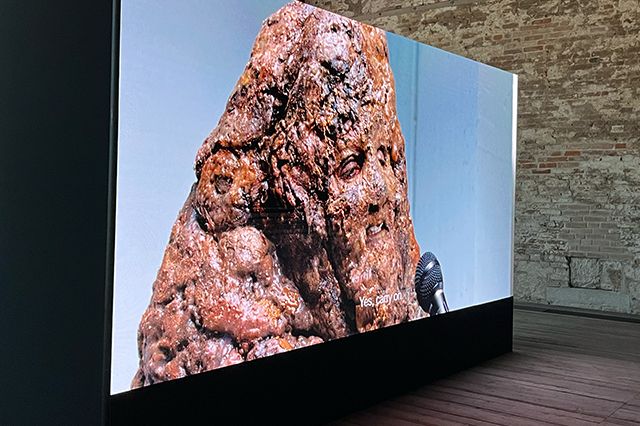
The installation integrates film, sound, and architecture into a single immersive work. It includes a film featuring an anthropomorphic excrement figure navigating life stages - appearing variously as puppet, 2D animation, and embodied presence - moving through scenes of hygiene classes, public transit, intimacy, and performance. Between these staged sequences, archival imagery drawn from art history, pop culture, and internet sources shows bodies in states of loss of control, creating what Bouvy calls a "collective memory of what society relegates."
Key thematic axes include:
- Shame as a social construct and political tool
- Abjection as resistance - waste and disgust become vehicles for critique, subverting conventions of acceptability
- Feminist and queer perspectives on how society produces bodies that are included or excluded
- Systemic violence embedded in norms of cleanliness and control
The project participates in current debates across contemporary art: ecological concerns about whether material waste mirrors social waste, post-human bodies, queer perspectives on desire, and institutional critique. Its subversive energy runs through every element.
Artist and Curator: Aline Bouvy and Stilbé Schroeder
This section introduces the key figures behind the Luxembourg Pavilion at the art exhibition La Biennale di Venezia 2026.
Aline Bouvy is a visual artist born in 1974 in Watermael-Boitsfort, Belgium. She lives and works between Brussels and Luxembourg, maintaining deep ties to the contemporary art scenes of both countries. She trained at the École de Recherche Graphique (ERG) in Brussels from 1995 to 1999, then studied at the Jan van Eyck Academie in Maastricht. Early in her career, she collaborated as a duo with John Gillis and co-founded the feminist collective The After Lucy Experiment before developing her solo practice from 2013 onward.
- Major solo exhibitions include Cruising Bye at MACS Grand Hornu (2022), Le Prix du Ticket (2024, Marseille), and Hot Flashes at Casino Luxembourg (2025), as well as presentations at Kunsthal Gent and in Berlin.
- Her practice spans sculpture, film, drawing, sound, and performance, consistently interrogating marginal bodies, urban space, and how minor keys of discomfort reveal larger systems of social control.
- She is the commissioned artist for the Luxembourg Pavilion at Biennale Arte 2026, her most prominent international platform to date.
Stilbé Schroeder is a culture curator born in 1985 in Luxembourg. She studied in Brussels and Strasbourg before returning to Luxembourg in 2015. She joined Casino Luxembourg - Forum d'Art Contemporain as exhibition coordinator, and served as assistant curator for the Luxembourg Pavilion in Venice in 2017 and 2019. The Stilbé Schroeder Casino Luxembourg Forum connection has been central to her development as a curator focused on critical, research-driven exhibitions.
- Her curatorial work emphasizes art acts that bridge institutional programming, publications, and exhibition-making in the d'art contemporain field.
- As curator of the Luxembourg Pavilion 2026, her vision shapes every dimension of how La Merde reaches its audience - from spatial design to the accompanying publication.
The collaboration between Bouvy and Schroeder reflects a close artist–curator dialogue. Their partnership ensures the Luxembourg Forum d'Art Contemporain exhibitor network and the Casino Luxembourg Forum d'Art ecosystem inform the project's ambition, while the work itself speaks to audiences far beyond Luxembourg's borders.
Luxembourg Pavilion Venice Biennale 2026: details
The Luxembourg Pavilion Venice Biennale 2026 is one of approximately 100 national participations at Biennale Arte 2026, connecting it to the sprawling geography of La Biennale di Venezia across the Giardini, Arsenale, and citywide venues. Each country independently commissions its own pavilion - selecting curators, artists, and projects that represent its cultural priorities on an international stage.
- Historic pavilions in the Giardini (around 29) contrast with rented spaces like the Sale d'Armi in the Arsenale (around 25), plus 40 or more pavilions scattered across the wider city - including newcomers like Equatorial Guinea and El Salvador presenting their own pavilion for new audiences.
- Luxembourg does not have a permanent pavilion in the Giardini; since 2019, its national pavilion has been housed in the Sale d'Armi under a long-term contract, placing it at the heart of the Biennale.
La Merde dialogues with neighbouring pavilions and the central curated exhibition through thematic resonances - ecology, the body, migration, decolonial issues - while its visceral, immersive tone offers a sharp contrast to more restrained or archival-based presentations.
Collateral events of La Biennale di Venezia complement the Luxembourg presentation: independent projects, institutional shows across Venice, and parallel initiatives from Luxembourg's cultural institutions extend the conversation inspired by the pavilion into a new space of discourse.
Luxembourg Pavilion Venice 2026: Exhibition Design and Visitor Experience
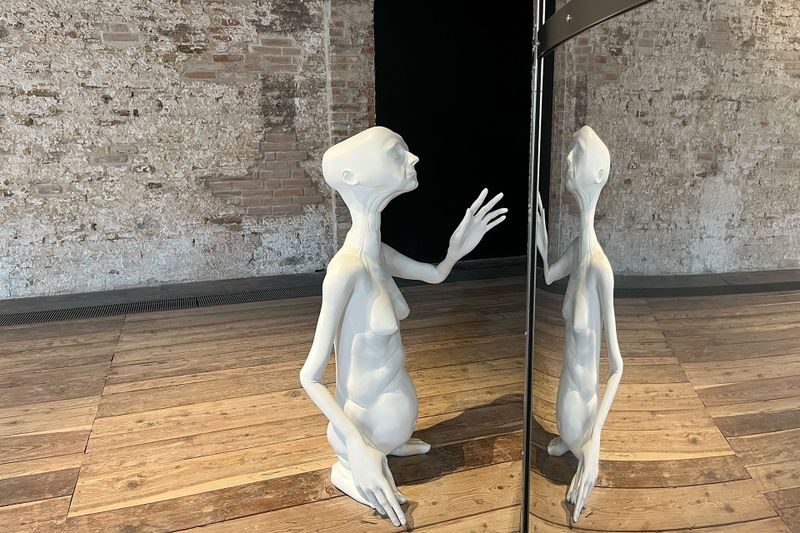
Entering the Luxembourg Pavilion Venice Biennale 2026 at the Arsenale, Sale d'Armi 1st floor, visitors encounter a semi-circular structure of mirror-clad steel architecture. The spatial design features mirror-clad steel architecture altering perception of space - walls, ceiling, and partitions create layered reflections that disorient and draw the viewer inward. This structure functions as both enclosure and what the project team calls a "communal headphone," reshaping how sound and life inside the pavilion are perceived.
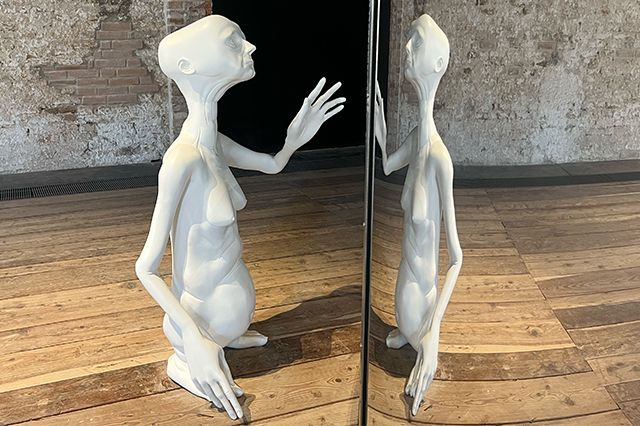
A large 4.5 × 2 meter LED screen anchors the film at the center of the space. Sound design by Pierre Dozin and Late Bush uses spatialised, evolving audio tools that shift in real time, making each visit slightly different. The sculptural presence of E.T. The Excremential - a hybrid figure merging pop-cultural reference with the artist's own body - stands as a physical anchor amid the reflections, music, and moving image.
For contemporary art professionals, the installation rewards close reading: references to Julia Kristeva's theory of abjection, archival strategies, and scenography by Antoine Rocca and Brice Dreessen. General visitors will respond to the sensorial push-pull of attraction and discomfort. Families or school groups should preview content via official channels - the themes are raw and provocative. A publication of approximately 300 pages accompanies the project as a manifesto reflecting on dejection, featuring essays by Robert Garnett and Jessica Gysel, with visual identity by Olivier Vandervliet. Wall texts and a printed leaflet are available on-site. Thibaud Leplat serves as assistant curator for the exhibition.
How to Follow and Engage with the Luxembourg Pavilion Venice Biennale 2026
Visitors and professionals can engage with the Luxembourg Pavilion Venice Biennale 2026 both on-site in Venice and remotely.
On-site: Attend during standard Biennale hours, join potential guided tours or walkthroughs on selected days, and look for meet-the-artist or meet-the-curator moments during opening week - especially around the 7 May 2026 press visit. Talks and performances tied to the project may also be present throughout the run.
Remote: The official Kultur | lx website hosts a dedicated project page with images, texts, and updates. Social media channels provide behind-the-scenes content and announcements about collateral events. The accompanying publication is available for purchase or download.
Always check the official La Biennale di Venezia website for last-minute changes to opening hours, ticketing, or programming. Whether you're a curator mapping your Arsenale route or a first-time Venice Biennale visitor, the Luxembourg Pavilion Venice Biennale 2026 and its Schroeder Casino Luxembourg Forum roots deserve a prominent spot on your itinerary.
FAQ
Below are answers to common questions about the Luxembourg Pavilion at the Venice Biennale 2026 not fully covered above.
Where exactly is the Luxembourg Pavilion located during Biennale Arte 2026?
The Luxembourg Pavilion Venice Biennale 2026 is situated in the Arsenale complex of La Biennale di Venezia, in the Sale d'Armi, 1st floor, at Campo della Tana 2169/F, Sestiere Castello, Venice. This places it among the main national participations of the 61st International Art Exhibition, in one of the most visited sections of the Biennale.
Who is representing Luxembourg at the Venice Biennale 2026?
The Luxembourg Pavilion 2026 features artist Aline Bouvy with the project La Merde, curated by Stilbé Schroeder. Bouvy is based between Brussels and Luxembourg with a background rooted in Belgium's and Luxembourg's contemporary art scenes. Schroeder brings curatorial experience from the Forum d'Art Contemporain in Luxembourg and prior Biennale editions.
Do I need a separate ticket to visit the Luxembourg Pavilion Biennale 2026?
No separate ticket is needed. Access is included in the general admission ticket to La Biennale di Venezia's Arsenale venues. The Luxembourg Pavilion Biennale 2026 is part of the official international art exhibition, and no extra fee applies.
Is the content of "La Merde" suitable for all audiences?
While the Luxembourg Pavilion Venice Biennale 2026 welcomes all visitors, La Merde uses strong bodily imagery, themes of waste, and critical humour that might be challenging for very young audiences. Families and educators should consider previewing materials via official channels before visiting. The museum-style setting offers contextual wall texts, but the content is intentionally raw and confrontational.
Conclusion
So, Artist Aline Bouvy and curator Stilbé Schroeder represent Luxembourg with La Merde, an immersive audiovisual installation exploring themes of abjection and social control through a critical, humorous feminist vision.
Here's what the Biennale says about it: "A mirrored structure creates layers of reflections that blurs the perception of the surrounding space. A life-size sculpture of E.T. (E.T. The Excremential, 2025) stands before the mirrored surface as if confronting its own reflection. The alien’s body results from a morphing between the original character and the artist’s own figure. (...) On the other side of the structure, the film La Merde is presented within an immersive, spatialised, dynamic viewing space."
Follow us Venice Insider Guide!
- The photos in this article of the Luxembourg Pavilion Biennale 2026 are the property of Venice Insider Guide.